
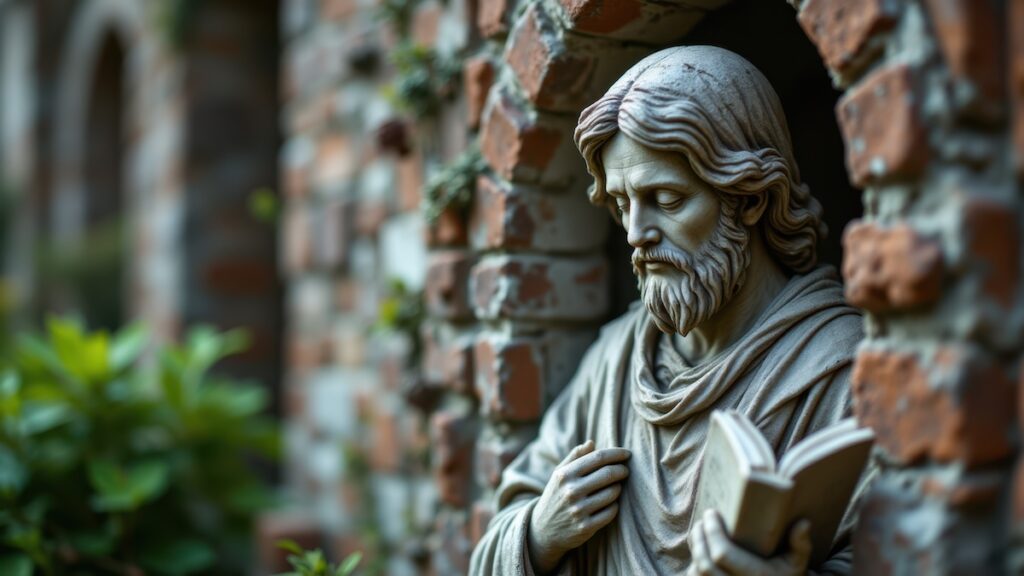
You’ve heard about him your entire life. You may even worship him as the Son of God and/or as someone whose world-famous teachings you seek to follow. But have you ever wondered specifically about Jesus’ time here on earth? Well, historians have for centuries, and they have come to some fascinating conclusions that can enrich and empower Freemasons. So let’s take a moment to look at what historians tell us about the historical Jesus.
“A Child is Born”
The first surprising thing historians tell us about the historical Jesus is that he likely was born a few years before we previously had thought—probably sometime between 7 BCE and 4 BCE (Before the Common Era), rather than in the year zero. Just as we have always believed, his mother and father were named Mary and Joseph and they did live in Nazareth. But two of our Gospels—The Gospel According to Mathew and The Gospel According to Mark—say Jesus also had brothers, whose names, according to Mark 6:3, were James, Joses, Judas (or Jude), and Simon. In fact, James, who met the Apostle Paul numerous times after Jesus’ death, was known as “James the Just” and was one of the most important early Christian leaders.
What Jesus Actually Said and Did
Because the Gospels tell little-to-nothing about Jesus prior to the start of his ministry, most of us have assumed he was a “carpenter” during his teens and twenties. But the Gospels—all of which were originally written in Greek and not Jesus’ native language of Aramaic—use the word “tekton” to describe his profession. While this can mean “carpenter,” it probably is better translated as “stone mason” or “general builder.”
Virtually all biblical scholars confirm that, at the age of about 30, Jesus was baptized by a Holy Man known as John the Baptist, and thereafter began his wandering ministry throughout Galilee. The four Gospels tell us what Jesus was reputed to have said and done thereafter throughout his ministry, although historians note that the first Gospel written after Jesus’ death—The Gospel According to Mark—was written about 40 years after Jesus’ death, in 70 CE (Common Era).
“The Jesus Seminar”
Because the Gospels were written so long after Jesus’ death, Bible scholars in 1985 convened what they called “The Jesus Seminar,” an international gathering to try to determine what the historical Jesus likely actually said and did during his amazing ministry. Their work was ultimately published in works such as The Five Gospels: What Did Jesus Really Say? and The Acts of Jesus.
Why Jesus Was Crucified
Although the Jewish people have been slandered by some for centuries as being responsible for Jesus’ crucifixion, most biblical scholars utterly reject this. Instead, they say Jesus was almost certainly crucified because he was known as “King of the Jews”—which was seen by Pontius Pilate and the Romans as a direct threat to their iron-clad rule of Judea.
Want to Learn More About the Valley of Portland?
Additional information about the Valley of Portland can be found on the Northern Masonic Jurisdiction Scottish Rite website and on our membership page. Interested in learning more about local events? Subscribe to our newsletter to stay up-to-date and informed about upcoming events.
New brothers interested in joining the Valley of Portland can do so by completing this online application.
